 |
| The exact spot where he died Yasser Qudaih |
Khuza'a is a village in the southern Gaza Strip, in the governorate of Khan Younis. There are about 12 thousand inhabitants, the center is just over a kilometer from the Israeli border and the movement restrictions created by the occupation forces are considerable. The fact that I'm about to tell takes place in Khuza'a, il 13 gennaio 2009, durante l'attacco genocida e terrorista di Israele detto “piombo fuso”. Non è l'unico episodio riferito a questo villaggio, e certamente non è nemmeno il più tremendo di quel periodo, ma vale la pena raccontarlo.
I personaggi narranti sono cinque diversi abitanti, tre donne e due uomini, che direttamente o indirettamente hanno vissuto quel momento.
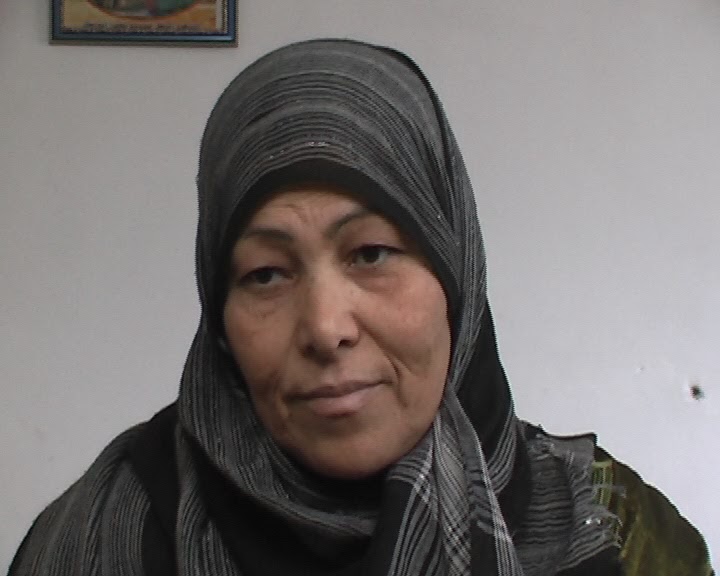 |
| Nada Aburoch |
Nada Aburoch, 53 year old woman
" During the invasion two years ago, during the genocidal attack that lasted three weeks, Israel used white phosphorus against us and other terrible weapons, my Mamdouh two eldest sons (22y.o.) and Medhat Aburok (17 years) helped the neighborhood administering first aid, even though they had no certificate or particular expertise, was horrible, people were dying and ambulances could not get the time because the snipers were still to shoot ... My oldest son, Mamdouh, was studying computer science at university, while working in a restaurant to pay for studies. After the Israeli attack with white phosphorus in Khuza'a (around January 10th) we went there with his family, and my two older sons were there. They wanted to guard the house because it was not torn down and continue to help the neighborhood. I was very worried, and what has happened since has confirmed my worst nightmares "
Qudaih Sabrin, 35 years, women:
" My husband Yasser Qudaih traded fruit and vegetables also grow anything here before. During the war we have strayed from Khuza'a because it was dangerous, we had refugees to Abusan (neighboring village) to my sister's house, because they were safer. My husband had returned during the cease-fire to see how the situation was: we were told that the Israelis were destroying all the empty houses, so he wanted to go see what was going on. Thought to be safe during the cease-fire, but it was not so. "
Gada Quiah, 34 years, women:
" Qudaih Mohammed was 15 years old, was my eldest son. He was a football fan, played in a small local team and loved it. A school was first class, the teacher remembers him with affection, came here to visit me once.
Since the invasion, you know, we had no electricity, recharge cell phones shop opposite the house that had the generator. It was the cease-fire and my baby was going to take ... when the disaster happened was right in front of the house, right here in front. "
 |
| Salem Mohammed Odeh |
Salem Mohammed Odeh , 31 anni, uomo:
“ Tutto è successo durante il cessate il fuoco. Le forze israeliane avevano concesso 3 ore di cessate il fuoco al giorno, ed in quelle 3 ore i tanti che erano scappati nei villaggi vicini approfittavano per venire a controllare le proprie case e prendere cose che servivano. Anche chi non era scappato sfruttava il momento per uscire a comperare i beni di prima necessità nei pochi negozi che aprivano.
Qui siamo al primo piano e giusto sotto casa c'è un negozio di alimentari. Sono sceso un time to buy something, there was a small group of people who had gathered in front of the shop. I remember they were talking about a guy who was running away from his home because he was too close to the border and panic had knocked at the wrong door, I do not remember exactly ... I was telling these people not to gather, not being all together, to disperse because even if they declared a cease-fire not to be trusted ... the Israelis were in heaven zannana a (drone) and two apache (helicopters) of the occupation forces.
I was struck by the explosion in the left leg, I lost a lot of blood, and they took me to the hospital with the same ambulance which carried the bodies of the dead. While waiting at the hospital I saw so many people get that I was afraid that all were dead or wounded Khuza'a "
Sabrin Qudaih :" My husband Yasser had just gone to see that had been our home, and to make children's clothing. When I heard the explosion I called Khuza'a to hear if my husband was well, and at the beginning I have said yes, they told me that my brother was dead. When I discovered that my husband had been killed during the explosion, was a tremendous trauma. The bomb caught him discharged dall'Apache right outside the door of his house as he spoke with a group of kids was outside the supermarket. It was just leaning against the wall, one meter away from the gate ... "
Nadra Aburoch :" My two eldest children, after three days away from the family that made sure that nothing happened to our house and were providing relief to the neighborhood in which they had finally decided to join us in Khan Younis. The eldest, Mamadouh, had found a car and stopped a moment to the area to predict Medhat shop and buy a snack. After the explosion they found part of the snack in the mouth of the corpse and hand in your pocket pants "
Quiah Gada" in front of the shop opposite the house where my baby was going to charge the phone battery had gathered a little 'people, and I heard a big bang. The street was full of blood and pieces of dead bodies, it was terrible, there was glass everywhere because all the windows of the building where there was the shop were too high, even those on the first floor of the dwelling. My son did not die immediately, he died an hour later, they had brought into the store where they were all waiting for the ambulance ... I still wore the jeans at the time.
 |
| Store Naji Qudaih |
Qudaih Naji, 49, is the owner of a small supermarket opposite which occurred the explosion. He moved the store a few hundred meters on the same street, the shop is very small, the size of a closet, when we interviewed him there was no current and the little light came through the metal door open.
" I opened the store during the cease-fire, also to provide a service to villagers who needed to stock up on essential goods and electricity to charge the batteries of mobile phones, in fact I had the generator running. Someone had gathered, and the Apache dropped a bomb right where the people had stopped talking. After the explosion we brought the wounded inside the store to provide first aid, because it was a dangerous area and they put a lot of ambulances to arrive. The ambulance arrived after 45 minutes ... not all the victims died at the time, 3 we have put in more time, I particularly remember a boy of 15 years (Mohammed Qudaih), was shot in the head, but when he entered the shop was still alive. If the ambulance was arrivata in tempo forse si sarebbe salvato.”
Otto palestinesi, padri di famiglia e ragazzini con delle vite “normali”, uccisi mentre chiacchieravano davanti ad un supermercato, da una bomba lanciata da un elicottero Apache israeliano:
YASSER QUDAIH, 34 anni, sposato, 5 figli
MOHAMMED QUDAIH, 15 anni
MAMDOUH ABUROUK, 22 anni
GASSON ABUZER, 23 anni
Alaa ABURIDA
Suliman QUDAIH
Mamdouh MOUSAID QUDAIH
Salem Mohammed Odeh 'C' were pieces of bodies of people murdered across the street, some pieces have also reached my terrace, including a portion of an arm ... other pieces of flesh were found the next day near the tree opposite, a scene I will never forget! If I think that the Israeli media have come to argue that they were militants resistance ... as you may think this is true? In this village is all flat, the border can see everything, is not the place for action of armed resistance, were all civilians, were dressed in civilian clothes ... Yasser was right opposite the entrance to the house, had been part of the resistance would not have been there! I remember at least 3 others wounded in addition to me: Hamdam Qudaih had a bad wound with a piece that was entered into head, but managed to have an operation in Egypt and is now healed, Idah Qudaih had shrapnel and debris all over the body , the company does have just entered the hospital, and was saved. Medath I remember that was 17 years and a large splinter in the stomach "
Nadra Aburoch : “il mio figlio secondogenito, Medath, aveva ferite e frammenti nelle gambe e nello stomaco, lo hanno operato ma non sono riusciti ad estrarre tutti i frammenti, talvolta se ne sentono ancora al tatto sotto la pelle e gli fanno molto male soprattutto quando fa freddo..un paio di mesi fa ne è stato estratto uno dal piede e giusto ieri se ne poteva sentire uno sottopelle vicino al ginocchio. Credo che col passare del tempo si muovano naturalmente verso la pelle, dopo si possono estrarre, ma provocano molto dolore. Oggi Medath ha problemi psicologici, è molto nervoso, fa fatica a sostenere una conversazione rimanendo calmo; io I have diabetes and high blood pressure, another 11 years of my son cries often and needed psychological support, which was provided by a local association. "
Gada Quiah "They killed my baby for no reason 14 years, my firstborn. I cried so much. I could not recover ... the door initially opened on our street where the massacre happened, today I opened another on a side street, because every time I went out I was sick of them, before the eyes of mind the blood and bits of bodies in the street, I see my son with the broken head, review my baby died. I took a psychological treatment to overcome the trauma, I have to take my 8 year old daughter who wakes up at night and comes looking for mom and dad crying and shaking as he hears the sound of airplanes or helicopters. all my four children have seen the horror in that way, the shreds of meat after the explosion, and they are all smaller than what has been assassinated: they bring in the nightmare forever ... We were just thinking of leaving the house when it happened the massacre "
 |
| Four of the sons of Sabri Qudaih |
Sabrin Qudaih : "now that my husband is dead, that was what worked at home, we live aid. The shock for me lasted a year, and I have to raise five children alone, I loved my husband. We Palestinians want our rights are respected, Israel must be punished for all crimes he committed during the genocidal attack two years ago and that makes every day. The Israeli media are liars, my husband was not in the resistance, was a civilian! What do you think that he would be killed in front of the house had been in the resistance? Children were massacred, nobody had weapons, had gathered because there was a shop next door, and, above all, everything has happened during the cease-fire! "
Naji Qudaih :" I am sure that none of the injuries that led to my shop had clothing that can be traced back to the uniforms of the resistance. No one 'among the wounded there' among the people that had gathered was armed. All the West talk about human rights, but it is a filling his mouth with words unnecessary, because when it comes to our human rights will not move a finger when it comes to Israeli crimes against our people in the West takes no position . When Israel is violating human rights are routinely ignored the facts. "
 |
| The coffee Gada Quidah |
Gada Quiah : "Israel has hit just because those people had gathered, it makes absolutely no distinction between civilians and resistance, between adults and children. No more will I bring back my child. The Israelis are the barbarians. Why kill Palestinian children in this way? Why our children can not have a life like any other children? "
Salem Mohammed Odeh : "Although Israel has bombed Lebanon in kindergartens, it behaves the same way in all countries, wherever they kill unarmed civilians. And you know why? Why in the world does not matter, because all do not care, because when these crimes does all look the other way. States, institutions, the UN, everyone is silent. No one tells him to stop. None. "
 | |
| marks left on the road by the bomb |


